The FREE video below is a section of a seminar lecture given by an instructor.
Below
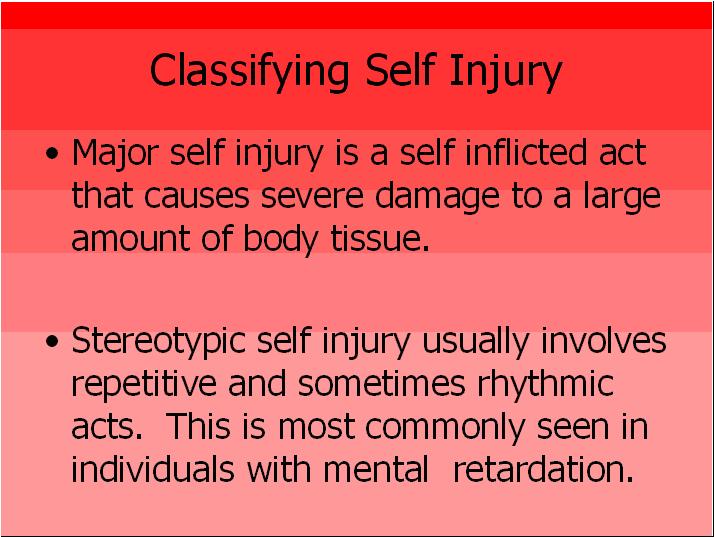
are the PowerPoints that accompany the instructor's lecture for this track. Question 3 found at the bottom of this page.
Reviewed 2023
Peer-Reviewed Journal Article References:
Franklin, J. C., Puzia, M. E., Lee, K. M., & Prinstein, M. J. (2014). Low implicit and explicit aversion toward self-cutting stimuli longitudinally predict nonsuicidal self-injury.Journal of Abnormal Psychology, 123(2), 463–469.
Mastin, T. M., Bautista, C. L., & Teng, E. J. (2020). Nonsuicidal self-injury in veterans with posttraumatic stress disorder: Current theory and implications for practice. Professional Psychology: Research and Practice, 51(4), 335–340.
Medina, M. (2011). Physical and psychic imprisonment and the curative function of self-cutting.Psychoanalytic Psychology, 28(1), 2–12.
Raudales, A. M., Weiss, N. H., Goncharenko, S., Forkus, S. R., & Contractor, A. A. (2020). Posttraumatic stress disorder and deliberate self-harm among military veterans: Indirect effects through negative and positive emotion dysregulation. Psychological Trauma: Theory, Research, Practice, and Policy, 12(7), 707–715.
Walker, T., Shaw, J., Gibb, J., Turpin, C., Reid, C., Gutridge, K., & Abel, K. (2021). Lessons learnt from the narratives of women who self-harm in prison. Crisis: The Journal of Crisis Intervention and Suicide Prevention, 42(4), 255–262.
Ward-Ciesielski, E. F., Schumacher, J. A., & Bagge, C. L. (2016). Relations between nonsuicidal self-injury and suicide attempt characteristics in a sample of recent suicide attempters.Crisis: The Journal of Crisis Intervention and Suicide Prevention, 37(4), 310–313.
Online Continuing Education QUESTION
3 According to the speaker, what is one major characteristic of many
repetitive cutters? To select and enter your answer go to CEU Test