The FREE video below is a section of a seminar lecture given by an instructor.
Below
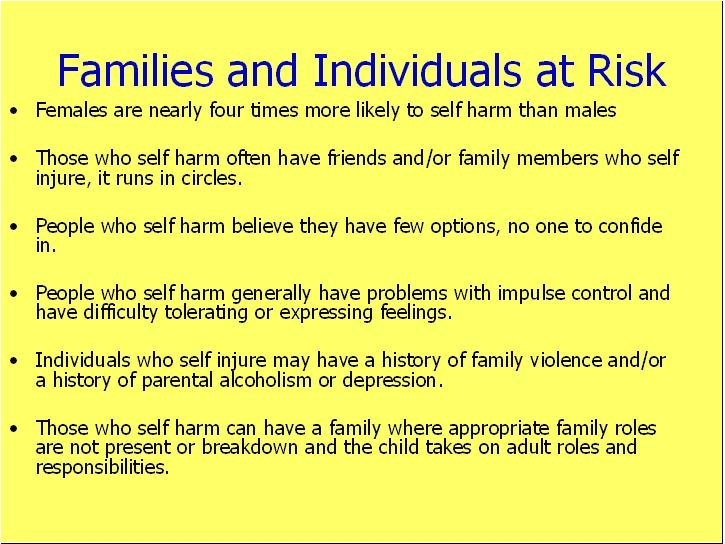
are the PowerPoints that accompany the instructor's lecture for this track. Question 6 found at the bottom of this page.
Reviewed 2023
Peer-Reviewed Journal Article References:
Adrian, M., Berk, M. S., Korslund, K., Whitlock, K., McCauley, E., & Linehan, M. (2018). Parental validation and invalidation predict adolescent self-harm.Professional Psychology: Research and Practice, 49(4), 274–281.
Ammerman, B. A., Jacobucci, R., Turner, B. J., Dixon-Gordon, K. L., & McCloskey, M. S. (2020). Quantifying the importance of lifetime frequency versus number of methods in conceptualizing nonsuicidal self-injury severity.Psychology of Violence, 10(4), 442–451.
Bustamante Madsen, L., Eddleston, M., Schultz Hansen, K., & Konradsen, F. (2018). Quality assessment of economic evaluations of suicide and self-harm interventions: A systematic review.Crisis: The Journal of Crisis Intervention and Suicide Prevention, 39(2), 82–95.
Clark, C. B., Li, Y., & Cropsey, K. L. (2016). Family dysfunction and suicide risk in a community corrections sample.Crisis: The Journal of Crisis Intervention and Suicide Prevention, 37(6), 454–460.
Emery, A. A., Heath, N. L., & Rogers, M. (2017). Parents’ role in early adolescent self-injury: An application of self-determination theory.School Psychology Quarterly, 32(2), 199–211.
Online Continuing Education QUESTION
6 What is one reason why the likelihood of self injury increases when
a cutter knows his or her family member or a friend self injures? To select and
enter your answer go to CEU Test