The FREE video below is a section of a seminar lecture given by an instructor.
Below
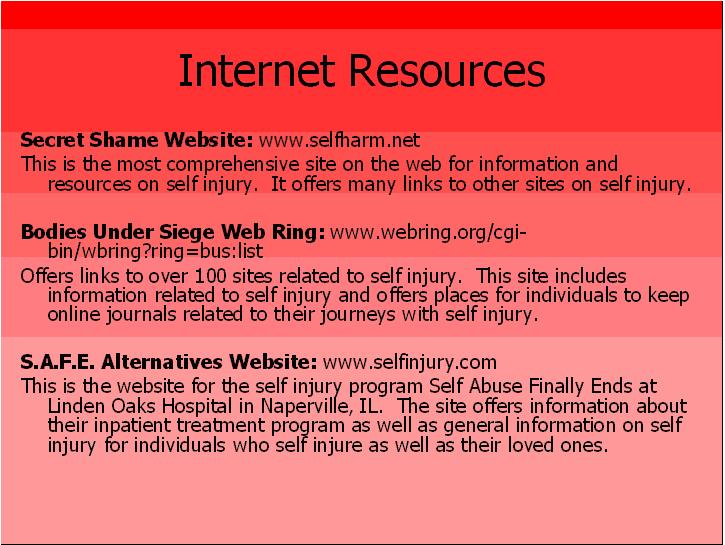
are the PowerPoints that accompany the instructor's lecture for this track. Question 14 found at the bottom of this page.
Reviewed 2023
Peer-Reviewed Journal Article References:
Andover, M. S., Schatten, H. T., Holman, C. S., & Miller, I. W. (2020). Moderators of treatment response to an intervention for nonsuicidal self-injury in young adults.Journal of Consulting and Clinical Psychology. Advance online publication.
Ammerman, B. A., Jacobucci, R., Turner, B. J., Dixon-Gordon, K. L., & McCloskey, M. S. (2020). Quantifying the importance of lifetime frequency versus number of methods in conceptualizing nonsuicidal self-injury severity.Psychology of Violence, 10(4), 442–451.
Glenn, J. J., Werntz, A. J., Slama, S. J. K., Steinman, S. A., Teachman, B. A., & Nock, M. K. (2017). Suicide and self-injury-related implicit cognition: A large-scale examination and replication.Journal of Abnormal Psychology, 126(2), 199–211.
Houben, M., Claes, L., Vansteelandt, K., Berens, A., Sleuwaegen, E., & Kuppens, P. (2017). The emotion regulation function of nonsuicidal self-injury: A momentary assessment study in inpatients with borderline personality disorder features.Journal of Abnormal Psychology, 126(1), 89–95.
Zestcott, C. A., & Stone, J. (2019). Experimental evidence that a patient’s tattoo increases their assigned health care cost liability.Stigma and Health, 4(4), 442–449.
Online Continuing Education QUESTION
14 What is the most important factor for the therapist to consider when
deciding if a behavior like getting tattoos or piercings is actually a form of
self injury? To select and enter your answer go to CEU Test